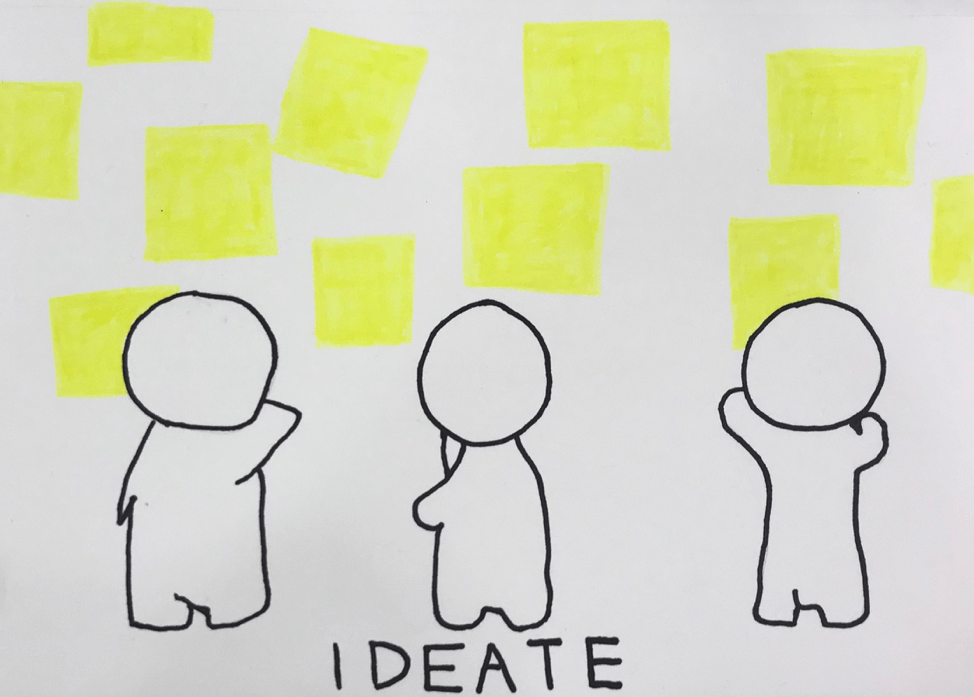
In the Ideate phase of Design Thinking, you must generate as many ideas as possible. During ideation, the quantity of ideas is important, and quality is not. It is essential to get the highest volume of ideas as possible because there needs to be diversity in your idea pool. Having diversity in ideation can spark more creativity and innovative solutions. To achieve diversity in all of these ideas, you have to suspend your judgments so that everyone feels comfortable sharing every idea they come up with. It is often hard to get people to ideate without feeling restricted or self-conscious in the ideation space. Commonly, people do not feel creative and feel they cannot come up with new ideas. This can be caused by creativity being ruined as a child, and people not realizing that ideation takes time, not inspiration.
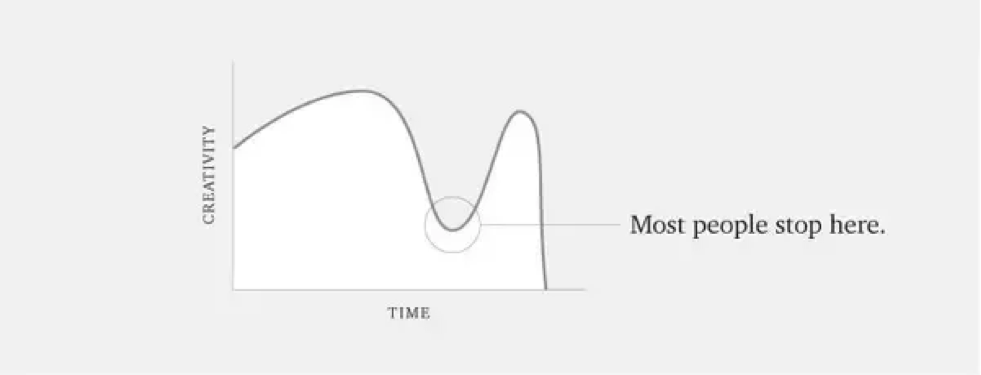
According to Stefan Mumaw in his Ideate Workshop at LinkedIn, when “weird” ideas are sparked, this is when creativity begins to flourish and innovative ideas are generated. As seen in the graph below, where most people stop ideating is when all the traditional idea flows cease. It is important to push through this. To push through this it is key to not pass judgment and record some unconventional ideas. Once the “weird” ideas are out, it sparks creativity and encourages people to think in different perspectives. As you can see from the graph below, the creativity peak is after the stopping point, this is why it is so crucial to share every idea. At this peak is where the most novel ideas are formed. In addition to reserving judgment, it is important to establish an environment where everyone feels comfortable and encouraged to share ideas in the ideation space.
Stefan Mumaw also made important references to his childhood, where he believes creativity is demolished. He shared how he was the only child in his class who raised his hand when asked, “Are you creative?”, by the teacher. Mumaw thought to himself, “I must have been wrong.” He feels that traditional education, where we are taught there is a certain process to obtain only one correct answer can blunder children’s creativity. It is important to note that the fear of being judged limits creativity. Mumaw also highlighted that kids are amazing at ideating and always have innumerable creative ideas, unlike adults. As a child, creativity is at its peak. Creativity must be embraced and fostered in children. In my opinion, if this was nourished as a child and improved upon and grown, we would be even better creators as adults and it would not be as daunting.
In addition to our education influencing our creativity negatively, adults find it extremely hard to be creative. They feel that people are either born with it or cannot be creative at all. If adults had enough time to be creative and were not as pressured by deadlines, they would have enough time to ideate and improve themselves. Christoph Niemann in his episode Illustration in the Abstract: Art of Design Netflix series states, “I worked under deadline at first… I got a lot of calls out of desperation.” He further explains how having harsh deadlines hinders the creative process, especially when you have a lot of other issues to handle at work. He claims these circumstances can ruin, “creators motivation,” hindering their willingness and ability to brainstorm innovative ideas. He explains the importance of taking the time to ideate, “Inspiration is for amateurs… professionals just go to work in the morning… it never becomes easy.” He continued to demonstrate the importance of needing the motivation to sit down and invest time and work hard to ideate. A Design Thinker does not need to be inspired to ideate, they have to go to work and be prepared to invest time to produce ideas. Time and patience are crucial factors to have successful ideation sessions. It is a common misconception adults have that they cannot be creative, the time just has to be dedicated to practice ideation.
As a species, people have been programmed as test-takers, crammers, and memorizers. Most of us have lost touch with our creative pathways, and they have been closed over time. We all need to learn how to reopen these creative pathways and be imaginative again, as we were in our youth. Creativity needs to be fostered as children to develop it and grow it. As a society, if we were to foster creativity and ideation at a young age, we would be raising innovators. We would be able to solve more problems, and everyone could be a creative being.
 Madison's Creative Blog