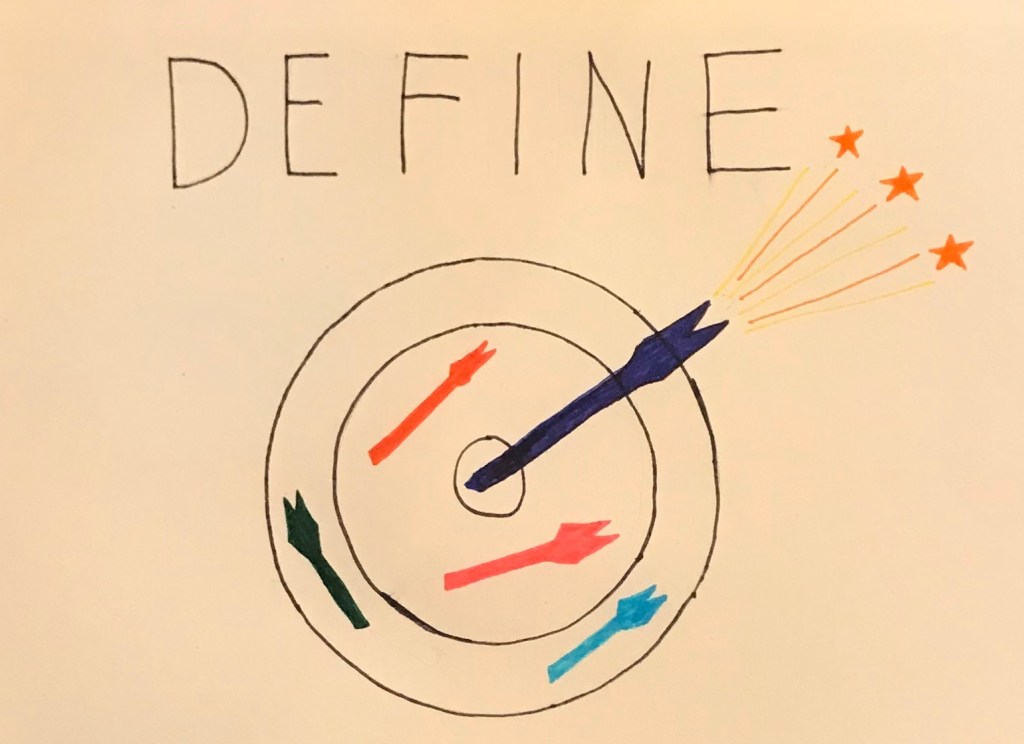
In the Define stage of Design Thinking, there is a lot of ambiguity and repetition. In this stage, it is key to dedicate copious time to hypothesize and define the problem for your target group. Defining the problem is very important but takes a lot of dedication and analysis, which is why it is often overlooked. As a designer, you should never assume you know the problem of a target group. You have to dig deep into the lives and concerns of your target group to see underlying issues you would not have seen from the surface level. To dig deeper you have to unpack the information you uncovered in the empathize step of Design Thinking.
When unpacking the information from the empathize stage, you cannot just assume you know the problem at hand. It is imperative to leave your judgments behind. You must not rush to define the problem since it requires time, space and repetition. Additionally, this process is not always linear and may require you to go back and get more data since you will be discovering things about your target group you could have never imagined. As a Design Thinker, you will be creating problem statements and redefining them numerous times as we go through this process. The “how might we” mindset will also help provide you with insights into the needs and feelings of your target group. The needs and feelings of your target group are imperative to have a successful product or service. If your product or service does not meet a need or satisfy a feeling, the design is worthless to your group.
In the Project Success: Defining the Problem video, led by Jordan Robert she emphasized the importance of a consumer’s needs, “Need to verify with the client you are creating what they want but it needs to be validated with consumers or it means nothing.” Jordan Robert brought her real-world experience working with clients and consumers to prove that consumer’s needs are extremely important. If you are working with your client to make something for the consumer, it’s relevance with the consumer must always be validated. If the product or service can not be validated with the consumer and does not help them satiate a need in their life there is no point in designing it. It is a waste of resources to design something that does not resonate with the consumer even if the client verifies it. If the consumer does not need this product no consumer will purchase it, regardless of how important it is to the client.
To meet the consumer needs, Design Thinkers need to rework and rethink problems to create the most innovative product or service for their clients. In the article, How Reframing a Problem Unlocks Innovation by Tina Seelig, she explains the importance of analyzing problems, “The simple process of asking why expands the landscape of solutions for a problem.” Tina brings up the key point that the deeper you dig into a problem, the more creative solutions will arise. Innovation takes time and requires problem redefinition and analysis to define the real root of the problem for a group. Once the real problems are explored and established, creative solutions will be born.
In addition to using Design Thinking in the corporate world, Design Thinking can be leveraged to solve social problems. In the Design Systems to Solve Social Problems Video by Nille Juul-Sørensen, he urges that, “we have to solve problems as a planet and learn from each other.” By integrating Design Systems thinking, we can work together as a planet to solve social problems. Nille explains the importance of collaborating and making this shift as a planet. He explains that by working together we offer so much more value than working separately since everyone in the world has so many different experiences. Design Thinking can be applied to more than just products and services. Design Thinking has the potential to solve so many issues that impact the world but we must start looking at the future from a design perspective. We have to keep redefining the social issues that are present in our world today. We have to be able to look at people’s needs in context and see the meaning behind these to decode people and their problems. Nonprofits are already starting to hire designers to help them create systems to solve all different types of social issues. In retrospect, if we apply Design Thinking outside the corporate world we will be able to help understand and solve social issues that affect all different areas of the world.
 Madison's Creative Blog