Prototyping with Empathy

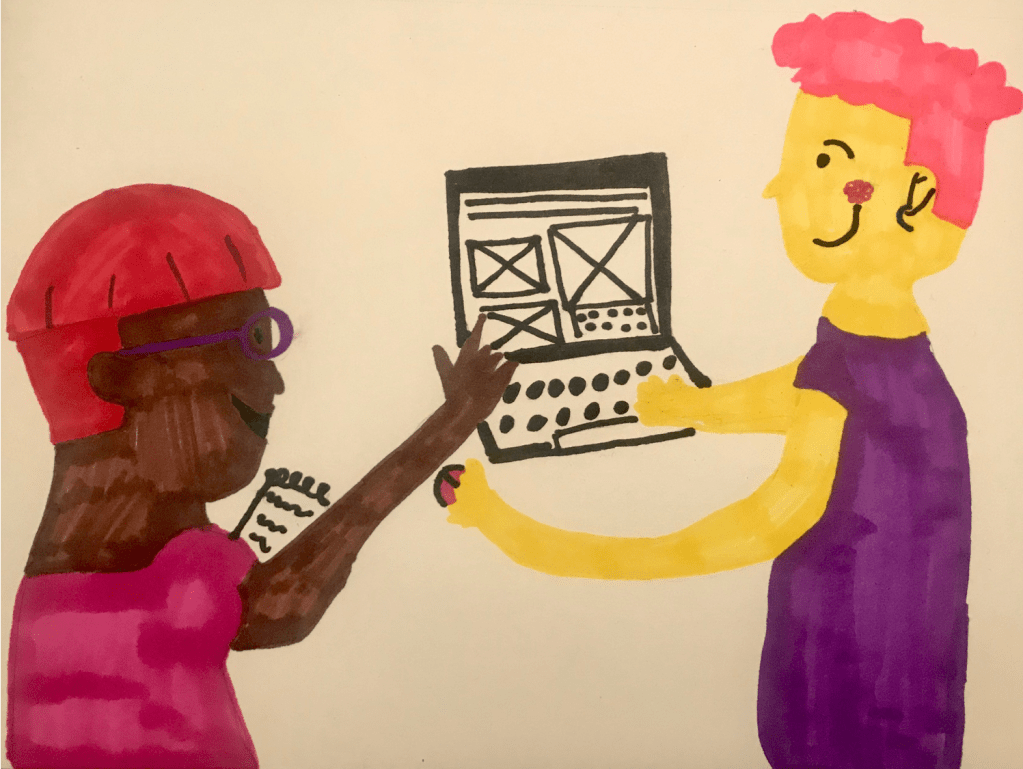
Following the Ideate phase in Design Thinking, is the Prototype phase. In the Prototype phase, designers create different varieties of prototypes. These range from paper prototypes, animatics, comprehensives, wireframes, walkthroughs, and moquettes. In this phase, you must explore, inspire and converse. During Prototyping, designers have to accept failure and make different iterations. Through making different prototypes, designers will discover different issues and improvements they can make to the model, which may require going back and revisiting phases. Commonly, unknowns will be discovered in the Prototype phase, so designers have to expect to make a lot of changes to improve their designs. Designers need to Prototype and design with the target group in mind, always empathizing with them or else the Prototypes will be useless.

In the Design Thinking: Get Started with Prototyping article by Rikke Dam and Teo Siang, they emphasize discovering the unknown through the Prototyping phase and the importance of action-oriented learning. Through action-oriented learning, you can discover exactly what you need to please the target market through prototyping and creating models. Through empathizing and prototyping you can create the best solution for the consumer. As stated by Rikke Dam and Teo Siang, “One of the most important aspects of Design Thinking is exploring unknown possibilities and uncovering unknown insights. This is the reason the discipline emphasizes learning and activities that increase the learning potential of the team.” Prototypes need to be built and fixed over and over again, to get the result that best fits the consumer’s needs, “As such, your team can iterate rapidly, modifying your test models and moving you closer and closer to the goal.” Making new iterations of the model is key to discovering the most innovative and best solution for the consumer.

Product Designer, Ian Spalter was featured on the Netflix Series Abstract the Art of Design Digital Product Design Episode. He was hired to help Instagram restructure their app and logo and prides himself in taking a lot of time in the Prototype phase. He requested three months and no questions from Instagram when prototyping and redesigning Instagram. He knows the importance of taking the time to redesign to meet the consumer’s needs. Ian Spalter also knew how to empathize with all different types of people, which he claims helps him immensely when needing to connect with the consumer in designing. Ian Spalter claimed his “empathy for people,” stemmed from him being biracial. Ian emphasizes the importance of reiterating, rewriting and redesigning to please an audience. He works for a platform that affects millions of people, so he has to make design decisions with what these people would like the best, not what he likes the best. Ian knows how to empathize so well with people that he is trusted to redesign Instagram, a global platform. Ian travels all over the world, and in this episode, he was seeing how people in Asian countries consume social media. He knows the differences in how various cultures consume media and he incorporated this in his restructuring of Instagram. Empathy is extremely important in all phases of Design Thinking, but especially prototyping. If you are not designing a prototype to solve a specific issue or interest for the target consumers, these prototypes are ultimately useless.  
Ideate: Quantity Over Quality

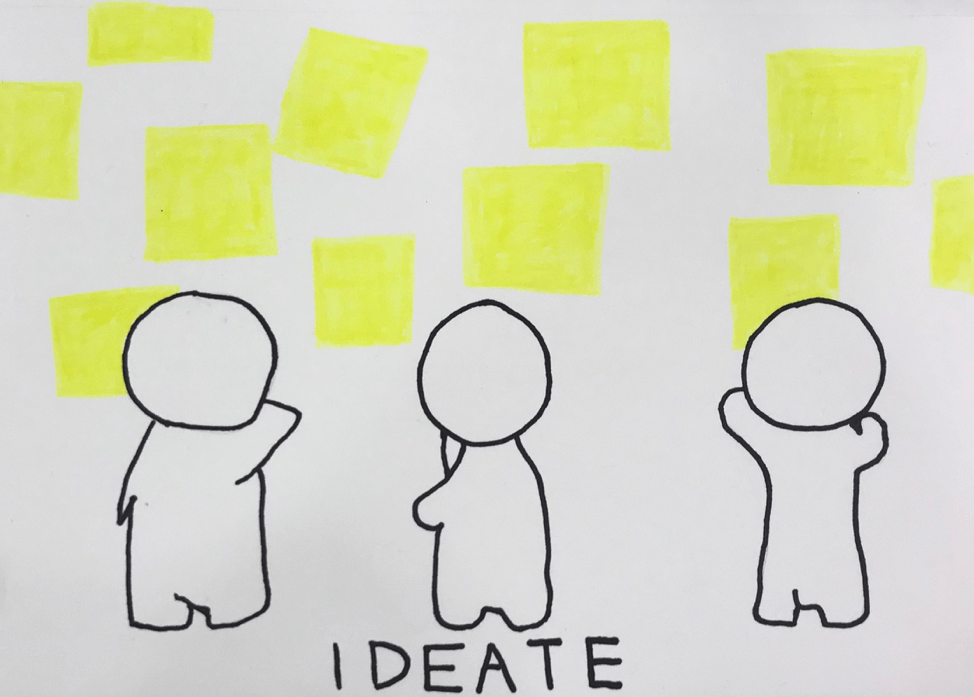
In the Ideate phase of Design Thinking, you must generate as many ideas as possible. During ideation, the quantity of ideas is important, and quality is not. It is essential to get the highest volume of ideas as possible because there needs to be diversity in your idea pool. Having diversity in ideation can spark more creativity and innovative solutions. To achieve diversity in all of these ideas, you have to suspend your judgments so that everyone feels comfortable sharing every idea they come up with. It is often hard to get people to ideate without feeling restricted or self-conscious in the ideation space. Commonly, people do not feel creative and feel they cannot come up with new ideas. This can be caused by creativity being ruined as a child, and people not realizing that ideation takes time, not inspiration.

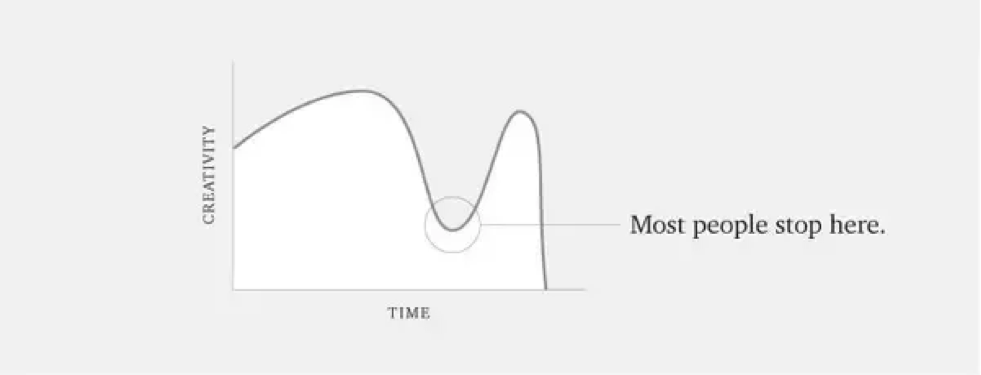
According to Stefan Mumaw in his Ideate Workshop at LinkedIn, when “weird” ideas are sparked, this is when creativity begins to flourish and innovative ideas are generated. As seen in the graph below, where most people stop ideating is when all the traditional idea flows cease. It is important to push through this. To push through this it is key to not pass judgment and record some unconventional ideas. Once the “weird” ideas are out, it sparks creativity and encourages people to think in different perspectives. As you can see from the graph below, the creativity peak is after the stopping point, this is why it is so crucial to share every idea. At this peak is where the most novel ideas are formed. In addition to reserving judgment, it is important to establish an environment where everyone feels comfortable and encouraged to share ideas in the ideation space. 

A picture containing object

Description automatically generated

Stefan Mumaw also made important references to his childhood, where he believes creativity is demolished. He shared how he was the only child in his class who raised his hand when asked, “Are you creative?”, by the teacher. Mumaw thought to himself, “I must have been wrong.” He feels that traditional education, where we are taught there is a certain process to obtain only one correct answer can blunder children’s creativity. It is important to note that the fear of being judged limits creativity. Mumaw also highlighted that kids are amazing at ideating and always have innumerable creative ideas, unlike adults. As a child, creativity is at its peak. Creativity must be embraced and fostered in children. In my opinion, if this was nourished as a child and improved upon and grown, we would be even better creators as adults and it would not be as daunting. 

In addition to our education influencing our creativity negatively, adults find it extremely hard to be creative. They feel that people are either born with it or cannot be creative at all. If adults had enough time to be creative and were not as pressured by deadlines, they would have enough time to ideate and improve themselves. Christoph Niemann in his episode Illustration in the Abstract: Art of Design Netflix series states, “I worked under deadline at first… I got a lot of calls out of desperation.” He further explains how having harsh deadlines hinders the creative process, especially when you have a lot of other issues to handle at work. He claims these circumstances can ruin, “creators motivation,” hindering their willingness and ability to brainstorm innovative ideas. He explains the importance of taking the time to ideate, “Inspiration is for amateurs… professionals just go to work in the morning… it never becomes easy.” He continued to demonstrate the importance of needing the motivation to sit down and invest time and work hard to ideate. A Design Thinker does not need to be inspired to ideate, they have to go to work and be prepared to invest time to produce ideas. Time and patience are crucial factors to have successful ideation sessions. It is a common misconception adults have that they cannot be creative, the time just has to be dedicated to practice ideation.

As a species, people have been programmed as test-takers, crammers, and memorizers. Most of us have lost touch with our creative pathways, and they have been closed over time. We all need to learn how to reopen these creative pathways and be imaginative again, as we were in our youth. Creativity needs to be fostered as children to develop it and grow it. As a society, if we were to foster creativity and ideation at a young age, we would be raising innovators. We would be able to solve more problems, and everyone could be a creative being.

Define Problems Everywhere

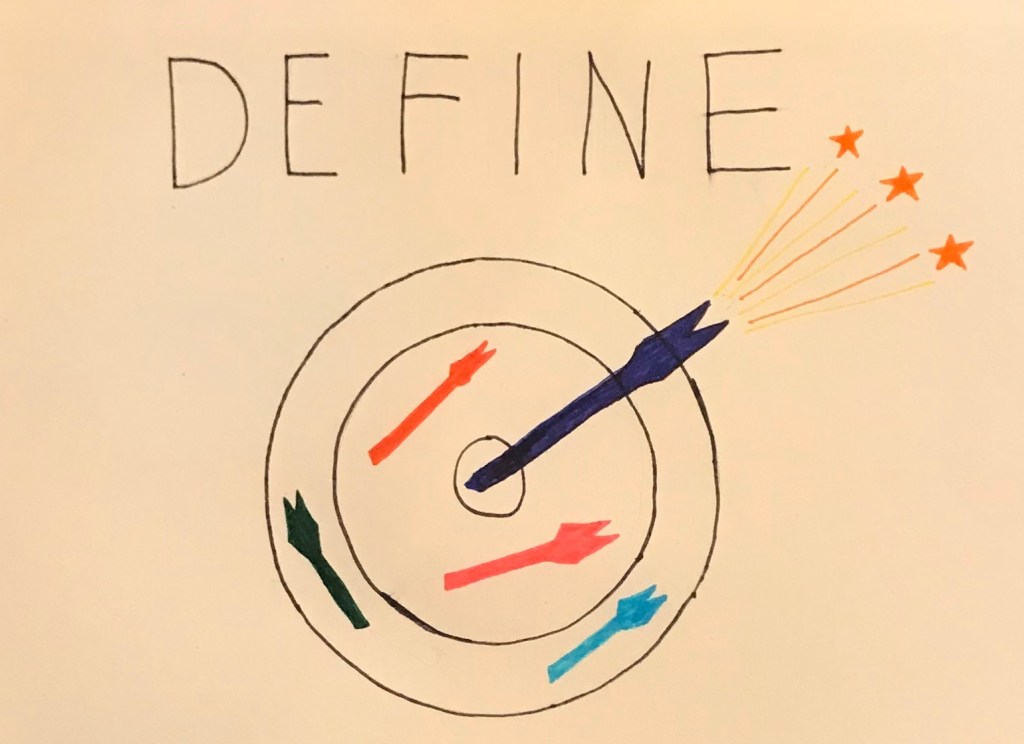
In the Define stage of Design Thinking, there is a lot of ambiguity and repetition. In this stage, it is key to dedicate copious time to hypothesize and define the problem for your target group. Defining the problem is very important but takes a lot of dedication and analysis, which is why it is often overlooked. As a designer, you should never assume you know the problem of a target group. You have to dig deep into the lives and concerns of your target group to see underlying issues you would not have seen from the surface level. To dig deeper you have to unpack the information you uncovered in the empathize step of Design Thinking.

When unpacking the information from the empathize stage, you cannot just assume you know the problem at hand. It is imperative to leave your judgments behind. You must not rush to define the problem since it requires time, space and repetition. Additionally, this process is not always linear and may require you to go back and get more data since you will be discovering things about your target group you could have never imagined. As a Design Thinker, you will be creating problem statements and redefining them numerous times as we go through this process. The “how might we” mindset will also help provide you with insights into the needs and feelings of your target group. The needs and feelings of your target group are imperative to have a successful product or service. If your product or service does not meet a need or satisfy a feeling, the design is worthless to your group.

In the Project Success: Defining the Problem video, led by Jordan Robert she emphasized the importance of a consumer’s needs, “Need to verify with the client you are creating what they want but it needs to be validated with consumers or it means nothing.” Jordan Robert brought her real-world experience working with clients and consumers to prove that consumer’s needs are extremely important. If you are working with your client to make something for the consumer, it’s relevance with the consumer must always be validated. If the product or service can not be validated with the consumer and does not help them satiate a need in their life there is no point in designing it. It is a waste of resources to design something that does not resonate with the consumer even if the client verifies it. If the consumer does not need this product no consumer will purchase it, regardless of how important it is to the client. 

To meet the consumer needs, Design Thinkers need to rework and rethink problems to create the most innovative product or service for their clients. In the article, How Reframing a Problem Unlocks Innovation by Tina Seelig, she explains the importance of analyzing problems, “The simple process of asking why expands the landscape of solutions for a problem.” Tina brings up the key point that the deeper you dig into a problem, the more creative solutions will arise. Innovation takes time and requires problem redefinition and analysis to define the real root of the problem for a group. Once the real problems are explored and established, creative solutions will be born.

In addition to using Design Thinking in the corporate world, Design Thinking can be leveraged to solve social problems. In the Design Systems to Solve Social Problems Video by Nille Juul-Sørensen, he urges that, “we have to solve problems as a planet and learn from each other.” By integrating Design Systems thinking, we can work together as a planet to solve social problems. Nille explains the importance of collaborating and making this shift as a planet. He explains that by working together we offer so much more value than working separately since everyone in the world has so many different experiences. Design Thinking can be applied to more than just products and services. Design Thinking has the potential to solve so many issues that impact the world but we must start looking at the future from a design perspective. We have to keep redefining the social issues that are present in our world today. We have to be able to look at people’s needs in context and see the meaning behind these to decode people and their problems. Nonprofits are already starting to hire designers to help them create systems to solve all different types of social issues. In retrospect, if we apply Design Thinking outside the corporate world we will be able to help understand and solve social issues that affect all different areas of the world.